Intent Data: What It Is and How to Use It for Sales (2026)

Intent Data: What It Is and How to Use It for Sales
You send 500 cold emails. 490 people don't care. 10 are interested. The question is: could you have known which 10 before you hit send?
That's the promise of intent data. And in 2026, it's moved from "nice to have" to the core of how top-performing sales teams prioritize their time.
TL;DR: Intent data tracks digital signals that indicate when a company is actively researching a solution like yours. First-party intent comes from your own website and product. Third-party intent comes from research activity across the web. The best approach combines both. Top providers include 6sense for account-level prediction, Bombora for third-party signals, and ZoomInfo for intent bundled with contact data. For structured, agent-ready buying signals with stakeholder mapping, see Trayo in Signal & Intent Tools. For free intent research, try the Trigger Event Finder skill.
What Is Intent Data?
Intent data is behavioral information that signals a company or person is actively researching a topic related to your product. These signals include content consumption patterns (blog posts, whitepapers, product pages), search activity, review site visits, competitor comparisons, and technology evaluations.
Think of it as the difference between cold calling a random list and calling companies that just spent three hours comparing your category on G2.
The concept isn't new. Marketers have tracked website visits for decades. What's changed is the scale and sophistication. Modern intent data platforms aggregate billions of signals across thousands of websites to build a real-time picture of which accounts are in-market.
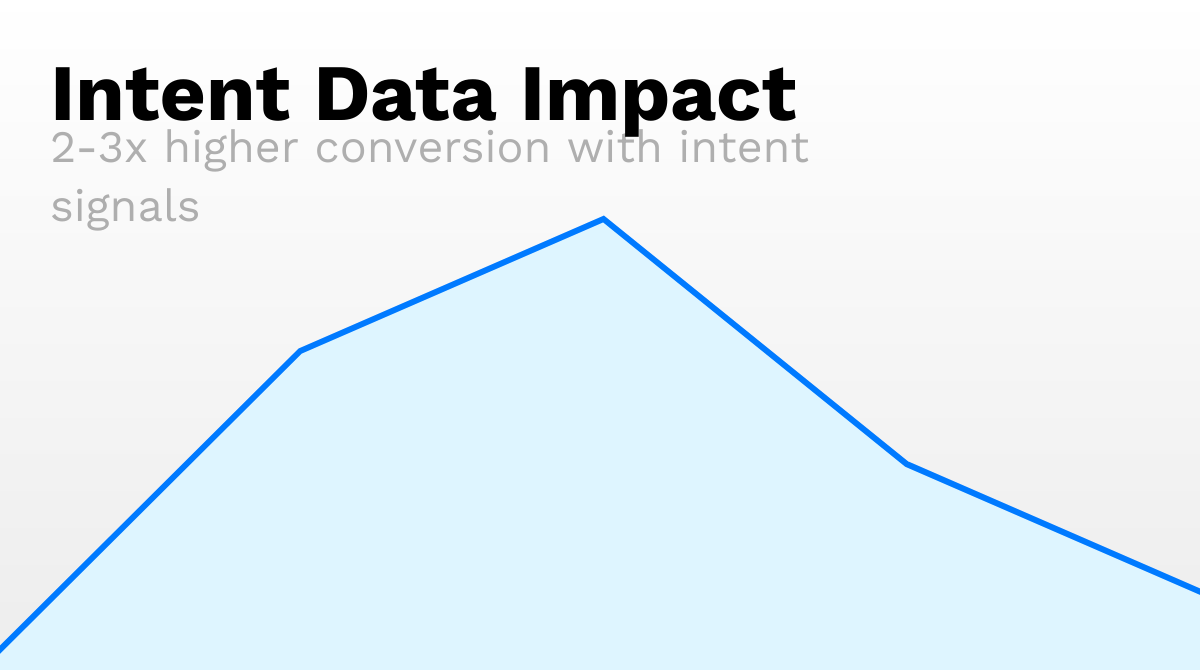
According to Forrester, B2B companies using intent data report 2-3x higher conversion rates on outbound campaigns compared to those using firmographic targeting alone. The B2B buyer intent data market itself is projected to reach $4.53 billion in 2026 (Research Nester), driven by the shift toward predictive, signal-based selling.
The Three Types of Intent Data
First-Party Intent Data
First-party intent data comes from your own digital properties. This is the data you already own but might not be using effectively.
Sources include:
- Website visits (especially pricing pages, competitor comparison pages, documentation)
- Product usage data (feature exploration, limit-hitting behavior)
- Email engagement (opens, clicks, link patterns)
- Content downloads (whitepapers, case studies, ROI calculators)
- Chatbot interactions and support queries
- Free tool usage (someone who uses Revenue Finder 5 times in a week is showing intent)
Strengths: Highest accuracy. These people are already on your site or using your product. The signal is unmistakable.
Limitations: Only captures people who already found you. Misses the 95%+ of your market that's researching elsewhere.
Tools that capture it: Google Analytics, HubSpot, Clearbit (reveals anonymous visitors), Dealfront/Leadfeeder, Warmly, RB2B.
Third-Party Intent Data
Third-party intent data tracks research activity that happens outside your own properties. This is the bigger opportunity, because most buyers do 70-80% of their research before ever visiting a vendor's website.
Sources include:
- B2B content consumption across publisher networks (Bombora monitors 5,000+ B2B sites)
- Search behavior and keyword research patterns
- Review site activity (G2, TrustRadius, Capterra page views)
- Social media engagement on relevant topics
- Job posting patterns (hiring for roles that use your product category)
- Technology adoption signals (installing complementary tools)
Strengths: Catches buyers early in the journey. Shows demand you'd never see from first-party data alone.
Limitations: Operates at the account level, not individual. Signal can be noisy. A junior analyst reading a blog post is a very different signal than a VP evaluating vendors.
Top providers:
| Provider | Signal Source | Coverage | Typical Cost |
|---|---|---|---|
| Bombora | 5,000+ B2B publisher network | Broadest third-party coverage | $25K-100K/year |
| 6sense | Multi-source AI predictions | Account-level predictions | $50K-130K/year |
| ZoomInfo | Proprietary + Bombora | Contact + intent combined | $15K-60K/year |
| G2 Buyer Intent | G2.com visitor activity | Software category research | Varies by plan |
| TrustRadius | TrustRadius visitor activity | Late-stage purchase research | Contact for pricing |
| Cognism | Bombora integration | European + global coverage | ~$12K/year |
Composite Intent (The Best Approach)
The smartest teams don't choose between first and third-party. They combine both into a composite intent score that weights signals based on reliability and recency.
A practical composite model:
High intent (act now):
- Visited your pricing page + downloaded case study (first-party)
- Surging on your category keywords on Bombora + viewing competitors on G2 (third-party)
- Hiring for a role that uses your product + recent funding round (contextual)
Medium intent (nurture):
- Reading educational content in your category (third-party)
- Engaged with your social content (first-party)
- Fits ICP firmographically but no strong behavioral signals yet
Low intent (watch):
- Single anonymous visit to your blog (first-party)
- General industry keyword activity (third-party)
- No behavioral signals but strong ICP fit
6sense does this natively. For teams without a $50K budget, you can build a version of this in Clay by pulling signals from multiple sources and scoring them with an AI formula. Read about building enrichment workflows in the data enrichment guide.
How Sales Teams Actually Use Intent Data
1. Prioritize Outbound Prospecting
The most common use case. Instead of working a static list alphabetically, reps start with accounts showing the strongest intent signals.
What this looks like in practice:
- BDR gets a daily feed of accounts surging on relevant keywords
- Each account includes the specific topics they're researching
- Rep personalizes outreach based on the research theme
- "I noticed your team has been evaluating [category]. Here's how companies like yours typically approach this..."
Impact: Teams using intent-prioritized lists consistently report 2-3x higher response rates on cold outreach compared to static ICP lists. The reason is simple: you're reaching out when the problem is already top of mind.
2. Account-Based Marketing (ABM)
Intent data tells ABM teams which accounts to target with ads, direct mail, and personalized campaigns.
What this looks like in practice:
- Marketing identifies accounts surging on category keywords
- Those accounts get targeted with LinkedIn ads, display ads, and personalized content
- Sales gets alerted when target accounts move from "research" to "evaluation" stage
- Coordinated outreach hits from both marketing and sales
3. Competitive Displacement Campaigns
Some intent platforms show which specific competitors an account is evaluating. This powers highly targeted displacement campaigns.
What this looks like in practice:
- 6sense or ZoomInfo flags accounts researching your competitor
- Rep sends outreach with a comparison angle: "Many teams switch from [Competitor] because of X. Here's what our customers say..."
- Marketing serves competitive comparison ads to those accounts
- See the competitive intelligence tools guide for platforms that track competitor activity
4. Churn Prevention
First-party intent data is powerful for retention. When existing customers start researching alternatives, you want to know immediately.
Warning signals to track:
- Customer contacts visiting competitor pages on G2 or TrustRadius
- Declining product usage or login frequency
- Customer researching your category keywords (they might be evaluating alternatives)
- Key champion leaving the company (job change alerts)
5. Pipeline Acceleration
For deals already in pipeline, intent data reveals what buyers are researching behind the scenes.
What this looks like in practice:
- Deal is stalled at the proposal stage
- Intent data shows the buying committee is researching a competitor
- Rep proactively addresses the comparison: "I know teams often compare us to [Competitor]. Here's the honest breakdown..."
- See how Gong combines conversation intelligence with buying signals in the sales enablement guide
Setting Up Intent Data (Without a $50K Budget)
You don't need a six-figure contract to start using intent signals. Here's a practical progression:
Stage 1: Free (Start Here)
Tools: Google Analytics, LinkedIn, Google Alerts, free skills
- Track which companies visit your website using Clearbit Reveal (free tier) or Leadfeeder (limited free plan)
- Set Google Alerts for your category keywords + competitor names
- Monitor LinkedIn engagement: who's liking, commenting on industry content
- Use the Trigger Event Finder skill to identify buying signals for any account
- Use Revenue Finder and Employee Finder to qualify accounts showing interest
Stage 2: Budget ($200-500/month)
Tools: Apollo + Clay + G2 Buyer Intent
- Apollo's buying signals show job changes, funding rounds, and technology adoption
- Clay can aggregate signals from multiple sources and score accounts
- G2 Buyer Intent (if you have a G2 listing) shows companies comparing your category
- Build automated alert workflows: when account fits ICP + shows signal, notify rep
Stage 3: Investment ($1,000-3,000/month)
Tools: Cognism (includes Bombora) or ZoomInfo with intent add-on
- Third-party intent data from Bombora's publisher network
- Keyword-level topic tracking customized to your category
- CRM integration pushes intent signals directly into Salesforce or HubSpot
- Automated routing: high-intent accounts go to senior reps
Stage 4: Enterprise ($50,000+/year)
Tools: 6sense or Demandbase
- AI-predicted account scoring combining multiple signal sources
- Buying stage prediction (awareness, consideration, decision)
- Competitor evaluation tracking
- Orchestrated campaigns across ads, email, and direct outreach
- Full RevOps integration with attribution modeling
Intent Data Pitfalls (What Nobody Tells You)
The False Positive Problem
Not every "intent signal" means someone is about to buy. An intern downloading a whitepaper for a college project shows up the same as a VP evaluating solutions. Third-party intent data is especially prone to false positives because it operates at the account level, not the individual level.
Fix: Always combine intent with firmographic fit. An account showing intent that matches your ICP is a strong signal. An account showing intent that doesn't fit your ICP is noise.
The Timing Gap
Third-party intent data typically has a 1-2 week delay. By the time you see a "surge" on Bombora, the research might have happened 7-14 days ago. In fast-moving categories, the buying committee might already be in late-stage conversations.
Fix: Use first-party signals (website visits, pricing page views) as your real-time layer. Third-party intent identifies accounts to watch. First-party intent tells you when to act.
The "Everyone Has It" Problem
Bombora powers intent data for dozens of platforms. If you're using Bombora through Cognism, and your competitor is using Bombora through ZoomInfo, you're both seeing the same signals and racing to the same accounts.
Fix: Differentiate with first-party data and research quality, not just speed. Use Clay to build custom research workflows that go deeper than what standard intent platforms provide. Read the sales intelligence tools comparison for platforms with proprietary intent data.
The Data Quality Decay
Intent signals decay fast. A surge from two months ago is worthless. Many teams set up intent tracking, get excited about the initial data, then stop acting on it consistently.
Fix: Build automated workflows that surface intent signals daily, not monthly. Set up Slack alerts, CRM task creation, or Clay automations that push actionable signals to reps in real-time.
Intent Data and AI: What's Changing in 2026
AI is reshaping how intent data works in three ways:
1. Signal aggregation is getting smarter. Tools like 6sense now combine intent signals, CRM data, email engagement, and website behavior into unified account scores. The AI weighs each signal's predictive value rather than treating them equally.
2. Natural language research at scale. Clay's Claygent can research any account using natural language queries: "Is this company likely evaluating CRM solutions?" This democratizes intent research for teams that can't afford dedicated intent platforms.
3. AI is generating new intent signals. LLM-powered tools can analyze earnings calls, job postings, news articles, and social media to identify buying signals that traditional keyword-based intent tracking misses. A company's CFO mentioning "digital transformation" on an earnings call is an intent signal that Bombora won't catch.
For a broader view of how AI is transforming sales tools, read the AI sales tools guide and the AI GTM guide.
Free AI Skills for Intent Research
Start identifying buyer intent signals today with these free AI skills:
- Trigger Event Finder — Find buying signals and trigger events for any account
- Prospect Research — Deep-dive research including buying indicators
- News Digest — Curated industry news that surfaces intent signals
- Tech Stack Analyzer — Identify technology adoption signals
- Competitor Intel — Track competitor moves that indicate market shifts
- ICP Builder — Define your ideal customer profile to filter intent signals
- TAM Calculator — Size the market opportunity for intent-driven campaigns
Frequently Asked Questions
What is intent data in B2B sales?
Intent data is behavioral information that indicates a company is actively researching a topic related to your product or service. It includes signals like web content consumption, search activity, review site visits, technology evaluations, and competitive comparisons. Sales teams use this data to prioritize outreach to accounts that are already in a buying cycle, rather than cold-calling into static lists. The two main categories are first-party intent (from your own website and product) and third-party intent (from research activity across the broader web).
How accurate is intent data?
Accuracy varies significantly by provider and signal type. First-party intent data (your own website visits) is highly accurate but limited in coverage. Third-party intent data (Bombora, G2) operates at the account level, not individual level, which means you know a company is researching but not always who specifically. According to practitioners, third-party intent data is most reliable when combined with firmographic fit signals. Used alone, it produces significant false positives.
What is the difference between first-party and third-party intent data?
First-party intent data comes from your own digital properties: website visits, product usage, email engagement, content downloads. You own this data and it's highly accurate but only captures people who already found you. Third-party intent data comes from monitoring research activity across the broader web: B2B publisher networks, review sites, search patterns. It catches buyers earlier in their journey but is noisier and less accurate at the individual level.
How much does intent data cost?
Free options exist: Google Analytics for website behavior, free CRM tools, and the Trigger Event Finder skill. Mid-range solutions like Apollo ($49-119/user/month) include basic buying signals. Cognism (from $1,000/month) bundles Bombora third-party intent. Enterprise platforms like 6sense ($50,000-130,000/year) and Demandbase offer the deepest intent capabilities. ZoomInfo (from $15,000/year) offers intent as an add-on to their data platform.
Can intent data replace cold outreach?
No, but it makes cold outreach dramatically more effective. Intent data doesn't eliminate the need to prospect. It tells you which prospects to prioritize and what messaging will resonate. Instead of sending the same generic email to 1,000 accounts, you send personalized, context-aware messages to the 50 accounts actually researching your category. The outreach is still "cold" from the buyer's perspective, but your targeting is warm. For cold outreach strategy, see the cold email guide.
What is the best intent data provider for small teams?
For teams with limited budgets, start with Apollo's buying signals (free tier available) combined with G2 Buyer Intent (if you have a G2 listing). Use Clay ($149/month) to aggregate signals from multiple sources. This gives you basic intent coverage for under $200/month. As you grow, add Cognism (includes Bombora) or ZoomInfo intent for broader third-party coverage.
Ready to build signal-driven outbound campaigns? The Clay MBA course teaches you how to combine intent data, enrichment, and automated outreach into a system that targets the right accounts at the right time.
Want to master Clay?
6+ hours of structured training
ClayMBA is my comprehensive course on becoming a top GTM engineer. Learn everything from basics to advanced workflows.
Explore ClayMBAWant to master Clay?
6+ hours of structured training
ClayMBA is my comprehensive course on becoming a top GTM engineer. Learn everything from basics to advanced workflows.
Explore ClayMBA