How to Build an Ideal Customer Profile for B2B Sales (2026 Guide)

How to Build an Ideal Customer Profile for B2B Sales
Most B2B teams have an ideal customer profile. Most of those profiles are useless.
TL;DR: An ideal customer profile (ICP) defines the companies most likely to buy, stay, and grow with you. Build one using data from your best existing customers, not gut feeling. Focus on firmographic filters (industry, size, revenue), technographic signals (tech stack), and behavioral triggers (hiring, funding). Use tools like Clay for enrichment, Revenue Finder for revenue estimation, and Apollo for firmographic filtering. A good ICP should fit on one page and be specific enough that your reps can qualify prospects in under 60 seconds.
They're either so broad that they describe half the companies on LinkedIn, or they're built on gut feeling instead of actual data. "We sell to mid-market SaaS companies" is not an ICP. It's a guess.
In my experience working with 200+ B2B teams through Clay MBA, the difference between teams that crush outbound and teams that struggle almost always comes down to one thing: how well they've defined their ideal customer profile.
This guide walks you through the exact ICP framework I teach. No theory. No fluff. Just a repeatable process you can use this week to build (or rebuild) your B2B ideal customer profile from scratch.
What Is an Ideal Customer Profile?
An ideal customer profile is a detailed description of the type of company that gets the most value from your product or service, and that you can serve profitably. It's a company-level definition, not a person-level one.
This is where most people get confused, so let's clear it up.
ICP vs Buyer Persona
Your ideal customer profile describes the company: industry, size, revenue, tech stack, growth stage, and the problems they face.
A buyer persona describes the person inside that company: their title, goals, frustrations, and how they make decisions.
You need both, but the ICP comes first. There's no point profiling the VP of Sales at a company that will never buy from you.
ICP vs Target Account List
Your ICP is the criteria. Your target account list is the output. The ICP defines the filters. The target account list is what comes out when you apply those filters to a database.
Think of it this way: if your ICP is the recipe, your target account list is the meal.
The 5-Step ICP Framework
Here's how to define your ICP using data instead of assumptions. I call this the 5-step ICP framework, and it works whether you're a seed-stage startup or a scaled sales org.
Step 1: Analyze Your Best Customers
Forget what you think your ideal customer looks like. Start with the customers you already have.
Pull a list of your top 20-30 customers based on:
- Revenue: Who pays you the most?
- Retention: Who sticks around the longest?
- Deal velocity: Who closed the fastest?
- Expansion: Who upgraded or bought more?
- NPS/satisfaction: Who actually likes working with you?
Rank your customers across these dimensions. The companies that score high on multiple factors are your real ideal customers, not the ones you imagined in a whiteboard session.
If you're pre-revenue or early-stage, use your best prospects or the companies that showed the strongest buying signals during discovery calls.
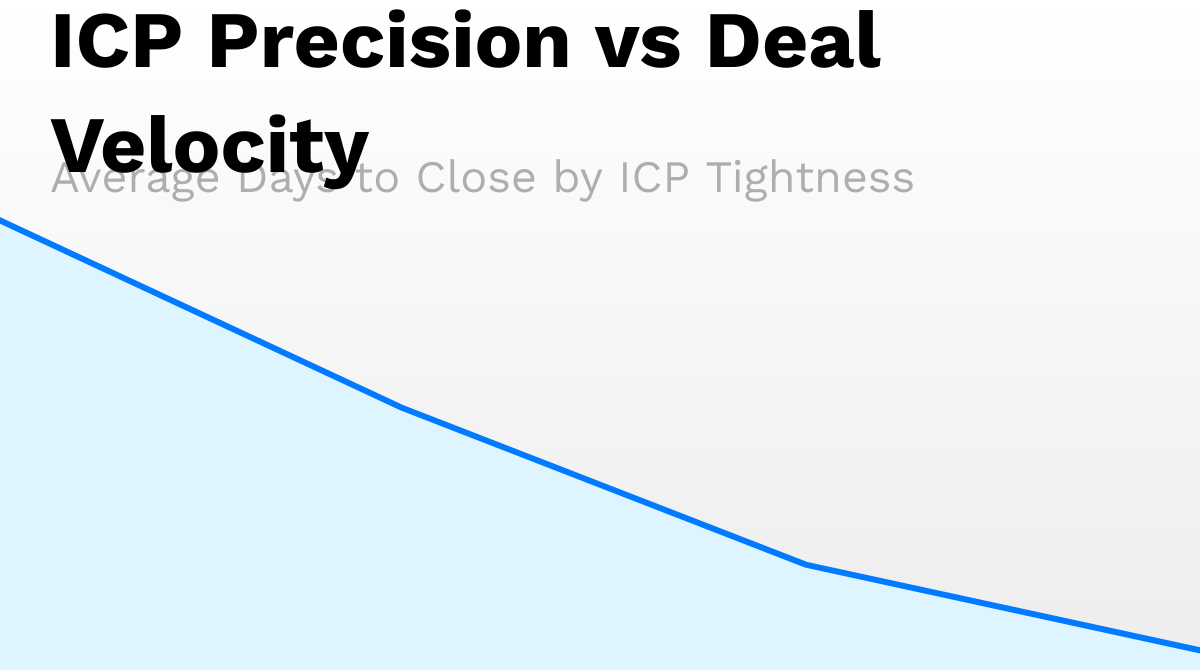
Tighter ICP definition leads to dramatically faster deal cycles. Signal-based targeting closes 4x faster than broad targeting.
Step 2: Find the Patterns
Now look at your top customers and find what they have in common. You're looking for patterns across three categories:
Firmographic data tells you the basics about a company: industry, employee count, annual revenue, location, and company structure. This is the foundation of any B2B ideal customer profile. Tools like ZoomInfo and Apollo are built for pulling firmographic data at scale.
Technographic data tells you what technology a company uses. If your product integrates with Salesforce, knowing which companies run Salesforce is gold. Clearbit and Clay can help you map the tech stacks of your best customers and find lookalikes.
Behavioral signals tell you what a company is doing right now: hiring for specific roles, opening new offices, raising funding, launching products, or adopting new tools. These are the signals that separate a good-fit company from a good-fit company that's ready to buy today.
Look at your top customers and write down every pattern you see. You'll start noticing clusters.
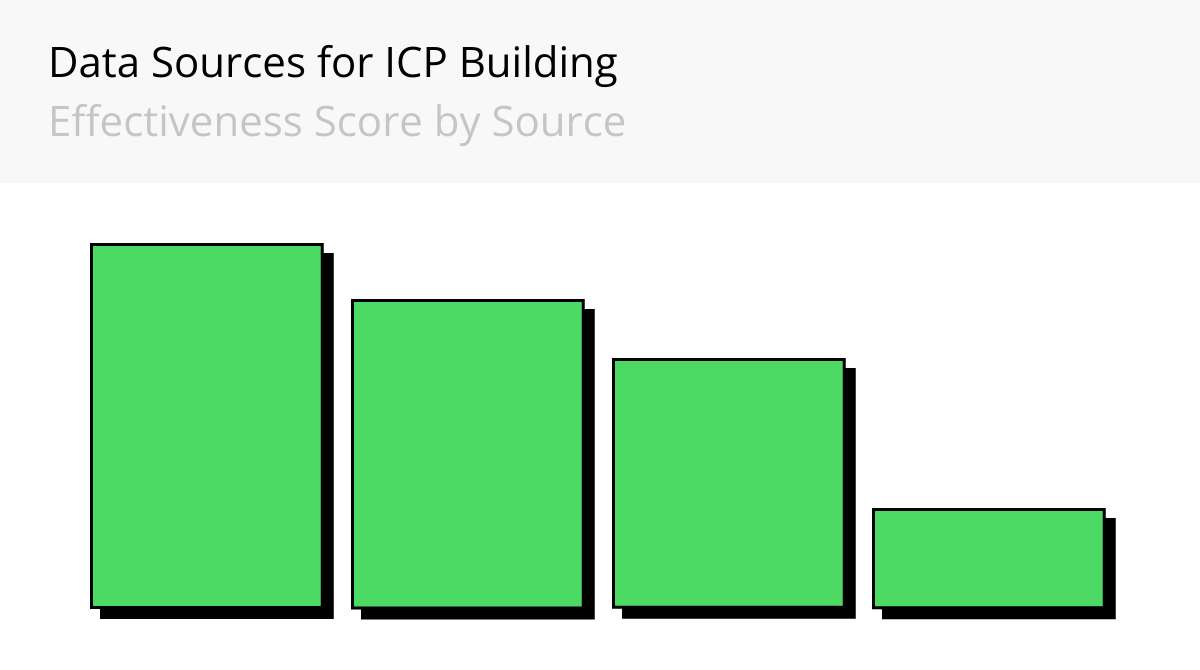
CRM data and customer interviews are the most effective inputs for building your ICP. Don't rely on gut feeling.
Step 3: Define Your Firmographic Filters
Now turn those patterns into concrete filters. This is where your ICP goes from "interesting analysis" to "actionable criteria."
For each dimension, define a range:
- Industry: Which verticals do your best customers cluster in? Be specific. "Technology" is too broad. "B2B SaaS with a self-serve motion" is useful.
- Company size: What employee count range? Use the Employee Finder to verify headcount data when building your lists.
- Revenue: What revenue range correlates with your best customers? The Revenue Finder can help you estimate company revenue when it's not publicly available.
- Geography: Does location matter for your sales process or product fit?
- Tech stack: Which technologies indicate a good fit? If your best customers all use HubSpot, that's a filter.
- Growth stage: Seed? Series A? Bootstrapped and profitable? Growth stage often predicts budget and urgency.
The goal is to get specific enough that when you apply these filters to a database, you get a list of hundreds or low thousands of companies, not tens of thousands.
Step 4: Layer in Intent Signals
Firmographic filters tell you who could buy. Intent signals tell you who's likely to buy right now. This is where modern ICP building gets powerful.
The intent signals that matter most for B2B sales:
- Hiring signals: A company posting for an "SDR Manager" or "RevOps Lead" probably needs outbound tools. Track job postings in your ICP companies.
- Funding signals: A fresh Series B means budget and growth pressure. These companies are actively looking to invest in their go-to-market.
- Tech adoption signals: A company that just adopted a tool that integrates with yours is a warm prospect. Technographic data providers can surface these changes.
- Content engagement: Companies researching topics related to your solution are showing intent. 6sense specializes in this kind of intent data.
- Leadership changes: A new VP of Sales or CMO often brings new tools and new strategies. Use the Owner Finder to identify decision makers at your target accounts.
Layer these signals on top of your firmographic filters, and you go from "companies that fit" to "companies that fit AND are likely in-market right now."
For a deeper dive on building signal-based workflows, check out our AI GTM guide.
Step 5: Validate with Data (Not Gut Feeling)
This is the step most teams skip, and it's the most important one.
Before you lock in your ICP, validate it:
- Test against your CRM data. Do your ICP criteria actually predict which deals close, which churn, and which expand? Run the numbers.
- Check the market size. Apply your ICP filters to a database like Apollo or ZoomInfo. Is your addressable market big enough to hit your revenue targets?
- Run a small campaign. Take 100 companies that match your new ICP and run a focused outbound campaign. Compare response rates and pipeline generated against your previous targeting.
- Talk to your sales team. Do the ICP criteria match what they see on calls? Sales reps know things that data doesn't always capture.
- Revisit quarterly. Your ICP isn't permanent. Markets shift, products evolve, and customer profiles change. Review and update at least every quarter.
The best teams I work with treat their ICP as a living document, not a one-time exercise.
Watch: Clay Platform Overview - see how to use Clay for ICP enrichment and scoring
Tools That Help You Build Your ICP
Building a data-driven ICP is much easier with the right sales tools. Here's what I recommend:
| Tool | Best For | Key Strength |
|---|---|---|
| Clay | Enrichment and scoring | Combines 50+ data sources in one workflow. Build ICP scoring models that update automatically. |
| Apollo | Firmographic filtering | Massive database with strong filters for company size, industry, tech stack, and more. |
| 6sense | Intent data | Surfaces which companies are actively researching solutions like yours. |
| ZoomInfo | Company data | Deep company profiles with org charts, financials, and technographic data. |
| Clearbit | Real-time enrichment | Enriches leads and accounts with firmographic and technographic data in real time. |
And don't overlook our free tools:
- Revenue Finder: Estimate company revenue when it's not publicly disclosed. Essential for revenue-based ICP filters.
- Owner Finder: Find the decision makers and company owners at your target accounts.
- Employee Finder: Verify company headcount to confirm they fit your size criteria.
The combination of Clay for orchestration with specialized tools for specific data points is the stack I see working best across the teams I advise.
The ICP Template: Your Usable Checklist
Here's the actual ideal customer profile template I use with my Clay MBA students. Copy it, fill it in, and share it with your team.
Company Firmographics
- Industry/Vertical: _____________
- Sub-industry (if applicable): _____________
- Employee count range: _____________
- Annual revenue range: _____________
- Geography/Region: _____________
- Company type: (SaaS, Agency, E-commerce, Services, etc.) _____________
- Growth stage: (Seed, Series A-C, Growth, Enterprise) _____________
- Business model: (Self-serve, Sales-led, PLG, Hybrid) _____________
Technology Profile
- Must-have tech: _____________
- Nice-to-have tech: _____________
- Disqualifying tech (competitor users): _____________
- Tech maturity level: (Early adopter, Mainstream, Laggard) _____________
Buying Signals
- Hiring for roles: _____________
- Recent funding: (Y/N, stage) _____________
- Leadership changes: (Y/N, which roles) _____________
- Tech stack changes: _____________
- Content/research signals: _____________
Qualification Criteria
- Budget indicator: _____________
- Pain points we solve: _____________
- Current solution (what are they using today?): _____________
- Decision-making structure: (Founder-led, Committee, Champion + Exec sponsor) _____________
- Typical sales cycle length: _____________
Disqualification Criteria
- Too small (under X employees/revenue): _____________
- Too large (over X employees/revenue): _____________
- Wrong industry: _____________
- Uses competing solution and locked in: _____________
- No budget authority at our entry point: _____________
Print this out. Put it on the wall. Make sure every SDR, AE, and marketing team member can recite the key criteria from memory.
Watch: How to activate your ICP with AI-powered cold email workflows in Clay
Common ICP Mistakes (And How to Avoid Them)
After working with hundreds of B2B teams, I see the same mistakes over and over:
1. Making It Too Broad
"We sell to companies with 50-10,000 employees in any industry." That's not an ICP. That's a prayer. The whole point of defining your ideal customer profile is to focus. If your ICP describes more than a few thousand companies, narrow it down.
2. Building It on Assumptions Instead of Data
Your CEO thinks the ICP should be enterprise financial services. Your data says your best customers are mid-market e-commerce companies. Trust the data. Always.
3. Confusing ICP with Buyer Persona
Remember: ICP is the company, buyer persona is the person. Build the ICP first, then layer in personas for the different stakeholders within those companies.
4. Setting It and Forgetting It
Markets change. Your product changes. Your customers change. If you built your ICP 12 months ago and haven't revisited it, it's probably outdated. Review quarterly at minimum.
5. Ignoring Negative Signals
Knowing who you don't want to sell to is just as important as knowing who you do. Add disqualification criteria to your ICP. Which company types consistently churn, take forever to close, or drain your support team? Exclude them.
6. Not Sharing It Across Teams
An ICP that lives in a Google Doc that nobody reads is worthless. Sales, marketing, product, and customer success all need to align on the ICP. If your marketing team is generating leads that don't match your ICP, you have an alignment problem, not a lead gen problem.
Build Your ICP Faster With Free AI Skills
If you want to shortcut this process, hansdekker.ai has free AI-powered skills built specifically for GTM teams:
- ICP Builder - Generate a data-driven ICP based on your best customers and market data
- GTM Playbook Generator - Build a complete go-to-market playbook from your website URL
- Persona Generator - Create detailed buyer personas that map to your ICP
- TAM Calculator - Estimate your total addressable market based on your ICP filters
- Targeting Ideas - Get 20 B2B campaign targeting ideas based on your playbook
- Prospect Research - Deep-dive research on specific accounts that match your ICP
- Competitor Intel - Understand how competitors define and target their ICPs
- Signal Scorer - Score prospects based on buying signals and ICP fit
- Tech Stack Analyzer - Analyze a company's technology stack for ICP qualification
Each skill is free to use and powered by AI. They work together as a system: start with the GTM Playbook, then use the ICP Builder to refine your targeting, and feed the results into Targeting Ideas for campaign angles.
Frequently Asked Questions
What is an ideal customer profile in B2B sales?
An ideal customer profile (ICP) in B2B sales is a detailed description of the type of company that is the best fit for your product or service. It includes firmographic data (industry, size, revenue), technographic data (tools they use), and behavioral signals (hiring, funding, growth indicators). Unlike a buyer persona, which describes an individual, an ICP describes the company.
How do you define an ICP?
The best way to define your ICP is to analyze your existing best customers. Look at which accounts generate the most revenue, retain the longest, and close the fastest. Find the patterns across firmographic data, technographic data, and behavioral signals. Then codify those patterns into specific, filterable criteria.
What is the difference between an ICP and a buyer persona?
An ICP describes the ideal company (industry, size, revenue, tech stack). A buyer persona describes the ideal person within that company (title, goals, pain points, decision-making process). You need both, but start with the ICP to make sure you're targeting the right companies before profiling the people inside them.
How often should you update your ICP?
At minimum, review your ICP quarterly. In fast-moving markets or during rapid product changes, monthly reviews may be necessary. Compare your ICP criteria against recent win/loss data, churn patterns, and pipeline velocity to identify any shifts.
What tools do you need to build an ICP?
You need tools for firmographic data (Apollo, ZoomInfo), technographic data (Clearbit), intent signals (6sense), and a platform to orchestrate and score it all (Clay). Free tools like Revenue Finder and Employee Finder can fill in specific data gaps.
Can a startup build an ICP without existing customer data?
Yes, but you'll need to use proxies. Look at who engaged most during discovery calls, who your competitors serve well, and what patterns exist in your pipeline even if deals haven't closed yet. Build a hypothesis-based ICP, then validate it aggressively with small, focused outbound campaigns. Expect to iterate quickly in the first few quarters.
Start Building Your ICP Today
A well-defined ideal customer profile is the foundation of every successful B2B sales and marketing operation. Without it, you're guessing. With it, every dollar you spend on outbound, content, and ads is more focused and more effective.
If you want to go deeper on how to build ICP-driven outbound workflows with tools like Clay, Apollo, and the full modern GTM stack, check out Clay MBA. It's where I teach the exact frameworks that 200+ B2B teams use to build pipeline.
Stop guessing. Start building your ICP with data.
Want to master Clay?
6+ hours of structured training
ClayMBA is my comprehensive course on becoming a top GTM engineer. Learn everything from basics to advanced workflows.
Explore ClayMBAWant to master Clay?
6+ hours of structured training
ClayMBA is my comprehensive course on becoming a top GTM engineer. Learn everything from basics to advanced workflows.
Explore ClayMBA